316 Stainless Steel Ball for Chloride Service Guide
2026-08-16


A forged steel ball is a grinding media sphere produced by hammering or pressing a heated steel billet into shape, then heat-treating it to a controlled hardness. Unlike cast balls, which are formed by pouring molten steel into a mold, forging physically deforms the metal, aligning its internal grain structure around the ball's shape. For mining and mineral-processing buyers, this difference is not academic. It decides how many hours a ball survives inside a semi-autogenous (SAG) or ball mill before it spalls, cracks, or wears down to a useless fragment. If you are comparing quotes from grinding media suppliers, understanding grain flow is the fastest way to tell a durable product from a cheap one.
Not all forged grinding media is built the same. Buyers typically choose between a few standard categories, and matching the right type to your mill conditions avoids overpaying or under-specifying.
Each type can be produced across the diameter range our facility handles — 9.525 to 26.987 mm as standard, with custom sizing available on request. For applications outside grinding, similar forged and precision-ground balls are used in bearings; see our high precision bearing balls line for comparison.
The defining feature of any forged steel ball is its grain structure. During forging, the steel's internal grains deform and flow to follow the ball's contour instead of sitting in random, brittle patterns like in cast media. This gives forged balls several measurable advantages:
Forged ball hardness typically runs higher and more uniform than cast equivalents of the same alloy, because the forging process closes internal porosity before heat treatment locks in the microstructure.
This is the section every buyer should study before signing a purchase order. Grain flow is the direction and continuity of the metal's crystalline structure after forming. In forged balls, the flow lines wrap around the ball's surface, similar to the grain in a river-worn stone. In cast balls, the grain structure forms randomly as the metal cools in the mold, often producing columnar or dendritic patterns with weak boundaries near the surface.
| Wear Factor | Forged Steel Ball | Cast Steel Ball |
|---|---|---|
| Grain structure | Continuous, oriented flow lines following ball contour | Random dendritic grains, weaker boundaries |
| Spalling resistance | High — cracks must cross grain flow to propagate | Lower — cracks travel easily along grain boundaries |
| Breakage under impact | Rare, mostly gradual surface wear | More frequent, especially in SAG mill impact zones |
| Hardness uniformity (through-section) | Consistent from surface to core | Can show soft cores or hard/brittle shells |
| Typical failure mode | Even abrasive wear, gradual diameter loss | Sudden fracture, half-ball breakage |
In practice, this means a mill charge of forged alloy steel balls tends to wear down evenly in diameter over its service life, while a cast charge is more likely to generate broken fragments that get rejected in the mill discharge — wasted metal that never contributed useful grinding work. If your plant already tracks scats (oversized ball fragments) in trommel screens, comparing scat volume between forged and cast charges is one of the simplest field tests you can run yourself.
Forged grinding media is used across comminution circuits where abrasive and impact wear both apply pressure on the media:
Outside mining, forged and precision steel balls also serve in mechanical components — for example, automotive CV joint steel balls require similarly controlled grain structure, though at much tighter dimensional tolerances than mill grinding balls. For a full breakdown of tolerance classes across ball types, our steel ball specifications and tolerances page covers the standard grades.
Price per ton for forged grinding balls varies with alloy content, diameter, and order volume. Buyers should budget around these variables rather than compare quotes on price alone:
A useful buyer's rule: don't just compare $/ton. Calculate cost per ton of ore processed by factoring in expected wear rate. A forged ball costing 8% more but lasting 20% longer usually wins on total grinding cost.
Before requesting a quotation, run through this checklist:
Common mistakes buyers make: choosing the cheapest quote without checking alloy grade, ignoring core hardness (a hard shell with a soft core still spalls), and ordering trial batches too small to reveal true wear-rate differences under real mill conditions.
Once forged balls are on site, a few practices extend their service life:
JHSteel Balls Co.Ltd. manufactures forged and precision steel balls across the 9.525-26.987 mm standard range, with annual output of 150-200 million pieces, and custom processing available to match specific customer requirements. Every batch runs through our intelligent quality checking system, using advanced inspection equipment to verify hardness, roundness, and surface condition before shipment. Buyers sourcing ball bearing chrome steel balls or grinding media from us get the same quality-control process applied across our full precision steel ball products range. If you want to see how balls are produced end-to-end, our steel ball production factory page walks through the process, and our article on steel ball manufacturing steps covers forging and heat treatment in more detail. If you are looking for a forged steel ball supplier, please feel free to contact us for the latest product quotation.
A forged steel ball is grinding media or a precision sphere made by mechanically deforming a heated steel billet under pressure, then heat-treating it. The forging step aligns internal grain flow around the ball's shape, which is why forged balls generally outperform cast balls in impact-heavy applications like SAG mills.
Forging closes internal porosity and orients grain flow continuously through the ball, so cracks must cross grain boundaries to propagate. This reduces spalling and breakage. Cast balls, by contrast, cool with random dendritic grains that offer easier crack paths, leading to more fragment breakage in service.
For high-impact SAG mills and hard-rock ore, forged alloy steel balls typically deliver longer, more predictable wear life and fewer broken fragments. Cast balls can be a lower-cost option for less abrasive, lower-impact secondary grinding circuits, but they carry higher breakage risk under heavy impact loads.
Hardness needs vary by ore type and mill design, and should be confirmed with your media supplier based on your specific application data. Buyers should always request both surface and core hardness figures, since a hard shell over a soft core still fails prematurely under impact.
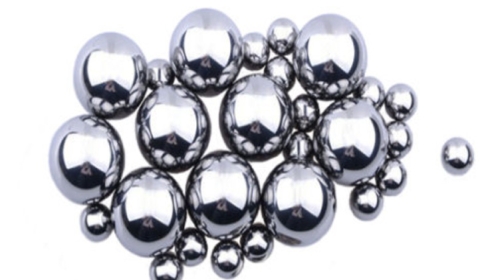
Contact JHSTEELBALLS to get high quality and precision steel balls for your applications, bearings lines and any other applicable places. We will reply within 24 hours