316 Stainless Steel Ball for Chloride Service Guide
2026-08-16

A grinding steel ball for mining is a high-hardness, wear-resistant spherical medium used in large rotating mills to break down and pulverize ore. Selecting the correct size and composition of these balls is not a minor detail; it directly impacts mill throughput, energy consumption, and the final particle size of the processed material. An incorrect choice leads to inefficient grinding, higher operational costs, and potential damage to mill liners. For procurement managers and mineral processing engineers, understanding the fundamentals of steel grinding media ensures that every dollar spent on consumables contributes directly to the mine's profitability and efficiency.
In mineral processing, a grinding steel ball for mining is the primary tool used inside a ball mill or SAG (Semi-Autogenous Grinding) mill to reduce the size of extracted ore. These are not the same as the high precision bearing balls used in machinery; they are engineered for extreme impact and abrasion. The process, known as comminution, involves lifting the balls and ore inside the rotating mill drum and allowing them to cascade and tumble, creating thousands of impact and attrition events that crush the rock. The effectiveness of this process depends entirely on the physical properties of the mining grinding balls, including their diameter, density, hardness, and chemical composition. A well-specified ball charge maximizes the energy transfer from the mill to the ore, achieving the target grind size with minimal waste.
The two dominant types of steel grinding media for mining are forged and cast steel balls. The manufacturing method significantly alters their internal structure and performance characteristics. As the technical team at JHSteel Balls, we have seen clients achieve better results by understanding this distinction. The choice between them depends on the specific grinding application, ore type, and mill operating conditions. Forged grinding steel balls are generally preferred for applications requiring high impact toughness, while cast balls offer specific hardness profiles for abrasion-heavy environments.
Here is a direct comparison to help guide your decision:
| Characteristic | Forged Steel Grinding Balls | Cast Steel Grinding Balls |
|---|---|---|
| Manufacturing Process | Heated steel bars are cut and hammered or rolled into a spherical shape, followed by heat treatment. | Molten metal alloy is poured into spherical molds and then heat treated. |
| Hardness Profile | High surface hardness with a more ductile, resilient core. Consistent hardness gradient. | Can achieve very high, uniform hardness throughout the ball (through-hardened). |
| Impact Toughness | Excellent. The forging process refines the grain structure, making it highly resistant to spalling and breakage in high-impact SAG mills. | Good, but can be more prone to fracturing under extreme impact compared to forged balls. Best for ball mills with smaller media. |
| Wear Resistance | Very good. Resists abrasive wear well, with a predictable wear rate. | Excellent, especially in high-chrome cast balls which are extremely resistant to abrasion in corrosive environments. |
| Common Use Case | SAG mills and primary ball mills with large diameter balls ( > 60mm) and coarse feed. | Secondary ball mills, regrind mills, and environments with highly abrasive or corrosive slurry. |
When specifying a grinding steel ball for mining, procurement managers should look beyond the initial purchase price and evaluate the features that determine its lifecycle cost and performance. High-quality mining mill grinding balls deliver consistent results and protect your milling equipment from unnecessary wear. The primary characteristics to assess are hardness, toughness, and chemical composition. A ball that is too soft will wear down quickly, increasing consumption rates. A ball that is too hard but brittle may shatter upon impact, contaminating the slurry and failing to perform its grinding function. The ideal ball balances these properties for your specific operating environment.
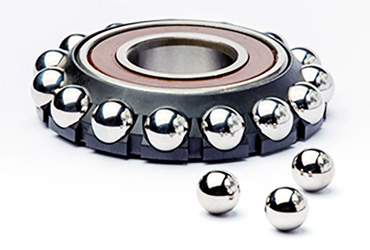
Steel grinding media for mining are fundamental to operations across the globe. Their primary function is to liberate valuable minerals from waste rock, a critical first step in the beneficiation process. Different mining sectors rely on ball and SAG mills for this size reduction. The efficiency of this stage sets the pace for the entire downstream recovery circuit, including flotation, leaching, and separation. At our steel ball production factory, we manufacture balls that serve a wide range of these demanding industrial steel ball uses.
Selecting the correct ball diameter is the most important decision when charging a mill. A ball that is too large will consume excess energy and may break coarse particles inefficiently, while a ball that is too small will not have enough impact energy to break the largest particles in the feed. The goal is to match the ball size to the feed size (F80, the size at which 80% of the feed passes) and the target product size (P80). As a general rule, the largest ball in the mill charge should be just heavy enough to break the largest piece of ore.
This selection chart provides a starting point for determining the appropriate grinding ball diameter based on mill type and feed size. Always consult with a grinding specialist to fine-tune the selection for your specific ore and circuit.
| Mill Feed Size (F80) | Mill Type | Target Grind Size (P80) | Recommended Top Ball Diameter |
|---|---|---|---|
| 150 - 250 mm | SAG Mill | 10 - 20 mm | 125 mm |
| 50 - 150 mm | SAG Mill / Primary Ball Mill | 5 - 10 mm | 100 mm |
| 10 - 20 mm | Primary Ball Mill | 1 - 2 mm | 80 mm |
| 2 - 5 mm | Secondary Ball Mill | 150 - 300 microns | 50 mm |
| 500 - 1000 microns | Regrind Mill | 45 - 75 microns | 25 - 40 mm |
When you need a reliable source for your grinding media, JHSteel Balls Co.Ltd. is your manufacturing partner. With an annual production capacity of 150-200 million steel balls, we can meet the demands of large-scale mining operations. Our manufacturing process covers a range of 9.525-26.987 mm steel balls, and we can produce custom sizes according to your specifications. Every grinding steel ball for mining that leaves our facility has passed through a complete intelligent quality checking system, verified by advanced inspection equipment. We are committed to providing high-quality, long-lasting steel grinding media that lowers your total cost of ownership and improves mill performance. If you are looking for a supplier of precision steel ball products, please contact us for a detailed quote.
The primary method is to use an empirical formula, like the Bond or Allis-Chalmers equations, which relate the required ball diameter to the ore's feed size (F80), work index, and the mill's critical speed and diameter. The selection chart provided above offers a simplified guide. For a precise calculation, you must know your ore's specific gravity and the desired product size (P80).
The ideal hardness depends on the ore's abrasiveness and the grinding mechanism. For highly abrasive ores in a wet grinding environment, a high-chrome cast ball with a hardness of 60-66 HRC may be best. For high-impact SAG milling with tough ore, a forged steel ball with a surface hardness of 58-64 HRC and a more resilient core is often superior to prevent breakage.
The main difference is the manufacturing process, which imparts different metallurgical properties. Forged balls are made by hot-working steel bars, creating a fine, tough grain structure ideal for resisting impact. Cast balls are made by pouring molten alloy into molds, allowing for higher chromium content and uniform through-hardness, which is excellent for resisting abrasion. The choice depends on whether impact or abrasion is the dominant wear mechanism in your mill.
Contact JHSTEELBALLS to get high quality and precision steel balls for your applications, bearings lines and any other applicable places. We will reply within 24 hours