
Bearing Steel Ball Manufacturer Application Matching Guide
2026-08-01


A bearing steel ball manufacturer is a factory that turns high‑grade steel wire or rod into precision spheres used in rolling‑element bearings, constant velocity joints, linear motion systems, and many other rotating assemblies. These are not generic metal marbles. They carry radial and axial loads, keep friction low, and maintain precise clearances between bearing rings. The right manufacturer does not simply ship catalog parts. They match ball grade, material chemistry, and surface finish to the actual operating conditions of the finished device — load, speed, lubrication, temperature, and even corrosion risk. When a buyer gets this match wrong, early spalling, noise, or complete bearing seizure is a matter of time. Getting it right starts with understanding what a bearing steel ball really is and what separates a capable supplier from a commodity vendor.
We typically see four material families in bearing ball production. Through‑hardened chrome steel balls (AISI 52100 / GCr15) dominate the rolling‑bearing world. They reach 60–67 HRC after heat treatment and deliver excellent fatigue life at moderate temperatures — up to about 150°C. For higher corrosion resistance, AISI 440C martensitic stainless steel balls provide similar hardness but hold up better in damp or mildly acidic environments. If the application runs hot or in aggressive chemicals, ceramic balls made from silicon nitride (Si₃N₄) are the go‑to. They are 40% lighter than steel, electrically insulating, and can operate without lubrication short‑term. Some OEMs use alloy steel or tungsten carbide balls for extreme loads or high‑wear services like check valves and downhole tools. Within each family, bearing ball grades run from G3 to G500, where G3 means a diameter tolerance of ±0.000125 mm. Most industrial bearing applications settle on G10 to G40, but high‑speed spindles demand G5 or better. Our factory’s ball bearing chrome steel balls go through automated optical inspection to guarantee grade compliance before shipment.
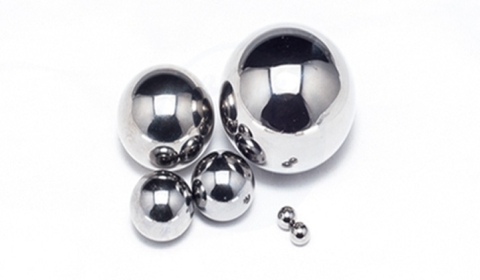
A bearing steel ball is defined by more than grade number. Five technical features decide whether the part works or fails early. Surface roughness (Ra) on a precision ball should sit between 0.02 and 0.05 µm. A mirror‑like finish reduces friction torque and lowers the risk of micro‑pitting. Hardness matters — a narrow spread of 1–2 HRC across a production batch tells you the heat‑treatment process is under control. Microstructure counts too. Balls that show evenly distributed fine carbides without retained austenite clusters last two to three times longer under cyclic load. Sphericity deviation must stay within the grade band; even a 0.5 µm out‑of‑round can set up vibration in a high‑speed spindle. Finally, cleanliness of the steel — low inclusion content rated by ASTM E45 — directly affects rolling contact fatigue life. At JHSteel Balls, every batch passes eddy current surface flaw detection and laser diameter scanning. The result is a consistent product that a bearing assembly line can feed at 200 parts per minute without worrying about dimensional drift.
You will find bearing steel balls wherever rotary motion and load meet. Deep‑groove ball bearings in electric motors, pumps, and gearboxes are the obvious use. But the automotive sector alone eats up 800 million bearing‑grade balls a year for wheel hubs, alternators, and steering columns. In constant velocity joints, automotive CV joint steel balls handle high articulation angles and shock torque from potholes — a real torture test for surface integrity. Linear motion guides in machine tools and semiconductor handling equipment rely on closely matched ball sets to maintain sub‑micron positioning repeatability. Slower‑moving but heavy‑load applications such as slewing bearing steel balls in tower cranes and wind turbines need hard‑won fatigue resistance because a single ball failure can halt a construction site or cut power output. Even a basic office chair gas spring contains tiny chrome steel balls that act as check valves. The range of uses is that broad, which is why a focused industrial steel ball manufacturer must keep multiple material and grade lines running in parallel.
Bearing ball pricing is not linear. A G100 chrome steel ball in 12.7 mm might cost pennies, but the same diameter in G5 Si₃N₄ can reach several euros per piece. Raw material choice is the biggest swing factor — ceramic is 10–20 times pricier than chrome steel. Grade jumps add cost because higher grades need longer grinding and lapping cycles. For example, moving from G40 to G10 can double the processing time, and that shows up in the unit price. Order volume plays its typical role. A run of 50,000 pieces gets you into automation‑friendly lot sizes; runs under 5,000 often carry a setup premium. Special testing, such as 100% eddy current inspection or lot‑by‑lot fatigue life testing, adds a surcharge but saves expensive field returns. Packaging affects pricing too: vacuum‑sealed anti‑corrosion packs are standard for export, and that cost is built into the quote. Buyers who ask for custom diameters outside our 9.525–26.987 mm standard product window should expect an upfront tooling fee, which we amortize if the contract hits a minimum volume.
Matching the ball to the application takes more than reading a datasheet. Start with load. A deep‑groove ball bearing carrying combined radial‑axial load needs a through‑hardened chrome steel ball with high core hardness, not a case‑hardened alternative. Speed is next. High‑speed spindles above 15,000 rpm generate centrifugal forces that can overwhelm the outer ring — lighter ceramic balls reduce that force and lower heat generation. Temperature calls the material. Chrome steel starts to soften around 150°C, so if the bearing housing runs at 180°C, move to either a heat‑stabilized variant or silicon nitride. Look at lubrication. If oil film formation is marginal — very low speed with grease, for example — you want a lower surface roughness (0.025 µm or better) to avoid metal‑to‑metal contact. For washdown environments in food or pharmaceutical machinery, 440C stainless or ceramic balls keep rust pits from becoming fatigue initiators. Always share the real‑world load spectrum and failure history with your bearing ball supplier. A quick phone call where you describe a 6‑month pitting failure pattern can narrow the grade and material choice faster than a stack of drawings.
JHSteel Balls Co., Ltd. is an industrial steel ball manufacturer that produces 150–200 million precision balls per year, covering diameters from 9.525 mm to 26.987 mm. Our focus is tight‑tolerance chrome steel, stainless, and alloy balls for bearing OEMs and CV joint assembly lines. The factory runs automated cold‑heading machines, heat‑treatment furnaces with controlled atmosphere, and a bank of lapping tables that hold 0.1 µm size consistency across batches. Every ball passes through laser optic sorting and eddy current crack detection before it leaves the floor. We keep a full precision steel ball products inventory for fast sampling and can shift to custom production when you need a specific grade or material that is not on the shelf. Our engineering team has worked on project‑specific challenges like reducing cage pocket wear through ball surface profiling and adjusting residual stress patterns for high‑cycle fatigue applications. If you are sourcing for a new electric drive module or an aftermarket bearing kit, we see the real benefit in sending you a batch of pre‑production samples with full dimensional and metallurgical reports so you can validate them on your test rig.
Look for a manufacturer who asks about your operating conditions before quoting. Check if they routinely produce the grade you need — if they make 80% G100 parts and you need G10, confirm whether the lapping capacity and metrology equipment can hold that tolerance in quantity. Ask to see an in‑process quality control log from a recent batch of your target size. Visit or send an audit team to inspect the eddy current and laser scanning stations. Ship small pre‑production lots and run them through your fatigue test rig or bearing assembly line. If the balls perform and the communication was direct, you have a candidate.
High‑load applications — crane slewing rings, rolling mill bearings, heavy gearboxes — usually work well with G20 to G40 chrome steel balls. Focus more on material cleanliness and heat‑treatment consistency than chasing an unnecessarily fine grade. G10 and G5 grades are value drivers in high‑speed, low‑load scenarios, not high‑load, slow‑rotation uses. Discuss case depth and core hardness with your supplier; for very high contact stress, specially heat‑treated alloy steel balls may outperform standard 52100.
JHSteel Balls supports custom diameter, grade, material, and packaging requests. If you need 15.875 mm G10 chrome steel balls with a specific oil coating for clean‑room assembly, we can set up a dedicated production run. Custom tooling usually pays back after 30,000 to 50,000 pieces, and we guide you through that economics discussion before you commit. Reach out with your requirement — we will send a feasibility note and sample quote within three working days.
If you are looking for a bearing steel ball manufacturer that can deliver the right grade and material for your application, contact JHSteel Balls today for a current quote and free technical review.
Contact JHSTEELBALLS to get high quality and precision steel balls for your applications, bearings lines and any other applicable places. We will reply within 24 hours
